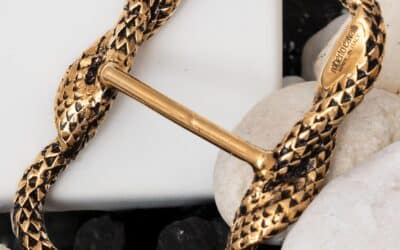
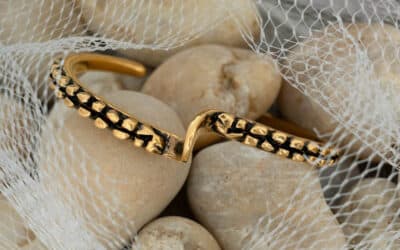
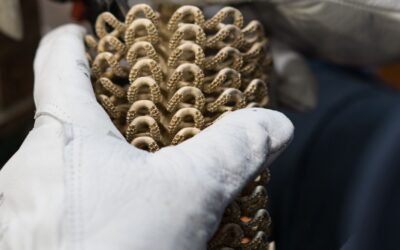
Micromet is an Italian lost-wax casting manufacturer based in Arezzo, in the historic goldsmithing district of Tuscany. We produce custom metal parts for fashion jewelry, luxury leather goods hardware, footwear accessories and apparel components, using lost-wax casting as our core production process — supported in-house by 3D CAD design, rapid prototyping, additive manufacturing and galvanic finishing.
This page explains how the lost-wax casting process works, the materials and applications we handle, and what it means to source from an Italian manufacturer that has built its expertise around this specific technique.
What is Lost-Wax Casting?
Lost-wax casting is a metal manufacturing process that produces a finished part from a wax model. The wax model is encased in a ceramic shell or plaster mould; the wax is then melted out (“lost”), leaving a cavity that mirrors the original shape. Molten metal is poured into the cavity, cools, and solidifies. Once the mould is broken or removed, the finished metal piece emerges, ready for finishing.
The technique allows the reproduction of fine details — engraving, intricate shapes, sharp edges, undercuts — that would be costly or impossible to obtain with stamping, machining or sheet metal forming. It is one of the oldest metal forming processes known (with archaeological evidence dating back over 6,000 years) and still one of the most widely used in modern fashion manufacturing.
Other names for the same process
Depending on the industry and language, lost-wax casting is also referred to as:
- Investment casting — the industrial term, commonly used for modern large-scale operations
- Precision casting — emphasises the dimensional accuracy of the process
- Cire perdue — the traditional French name, still used in jewelry and fine art
These names describe the same underlying process. At Micromet, we use “lost-wax casting” and “investment casting” interchangeably depending on the context.
The lost-wax casting process at Micromet step by step
Our in-house lost-wax casting workflow runs through seven phases, all coordinated within the same facility:
- 3D CAD design. We start from customer drawings, 3D files (STEP, IGES) or physical samples. When needed, our technical team builds the 3D model from scratch in close collaboration with the client.
- Master model and silicone mould. The 3D file is used to produce a master model, around which a silicone mould is built. The mould will be the matrix for producing the wax patterns.
- Wax injection. Molten wax is injected into the silicone mould to produce identical wax models, one for each finished piece.
- Tree assembly. Multiple wax models are mounted on a central wax channel, forming a “tree”. This allows multiple pieces to be cast in a single cycle.
- Investment (ceramic shell). The wax tree is dipped into a ceramic slurry and coated with refractory material, creating a hard shell around the wax. Once cured, the shell is heated: the wax melts out and is recovered, leaving the empty mould.
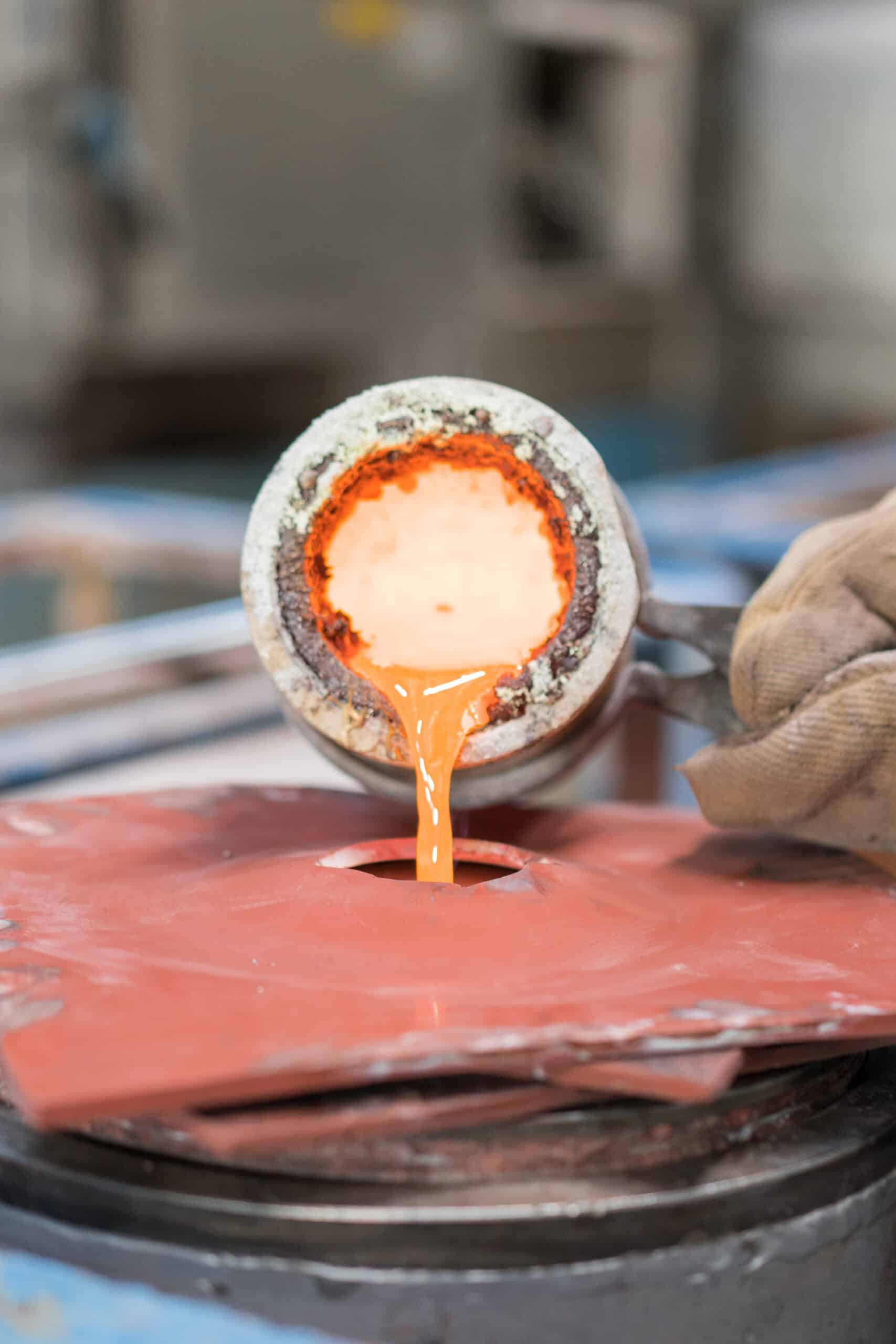
- Casting. Molten metal — brass, bronze, silver or other alloys — is poured into the hot ceramic mould. The metal fills every cavity, including the finest details of the original wax models.
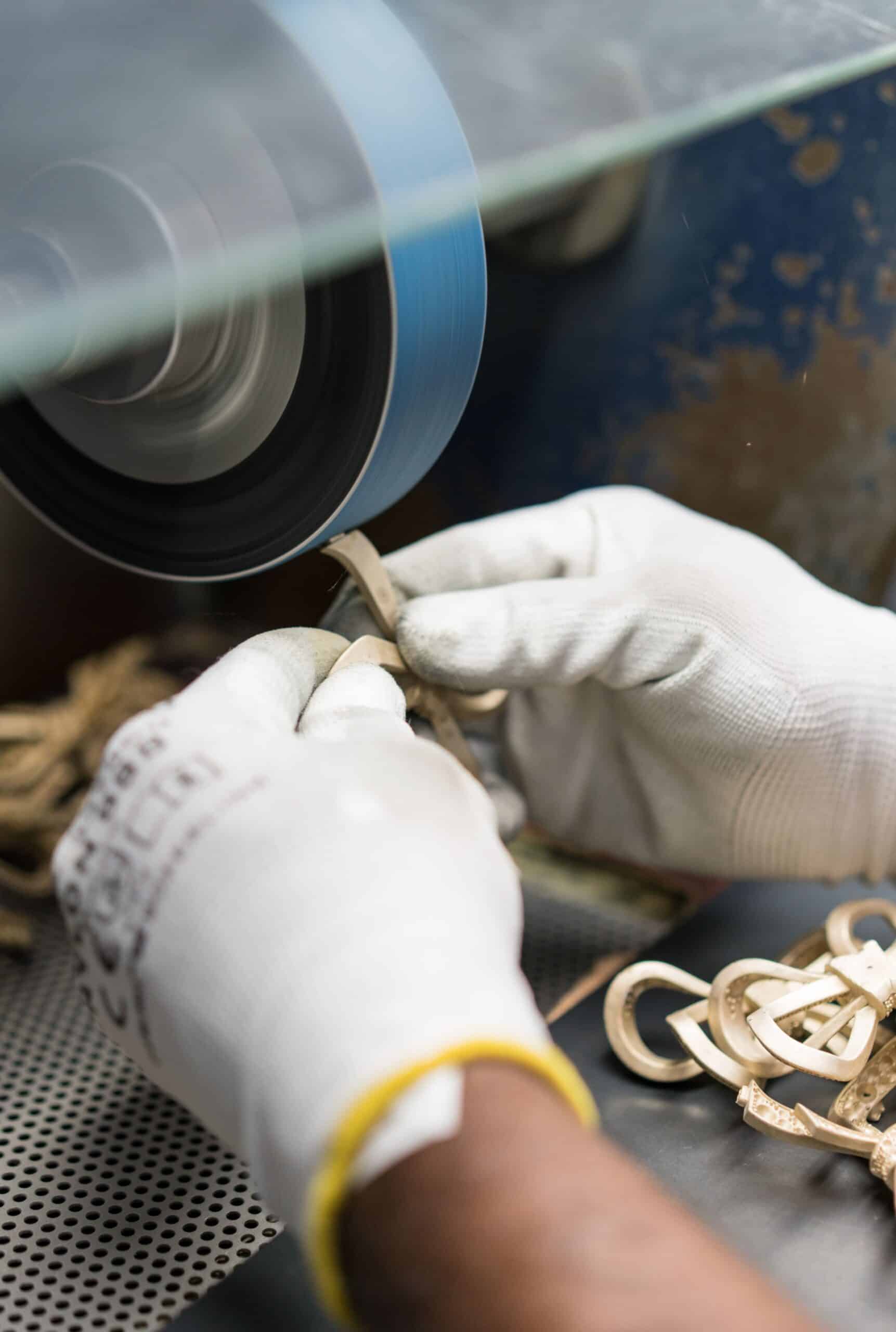
- Finishing. Once cooled, the ceramic shell is broken away and the individual pieces are cut from the metal tree, cleaned, polished, and sent to our galvanic finishing department for plating, PVD coating or other surface treatments.
For prototyping and small series we often combine lost-wax casting with rapid prototyping to validate form and dimensional fit before committing to the master model.
Silicone Mold Creation Phase

Wax Model Production Phase
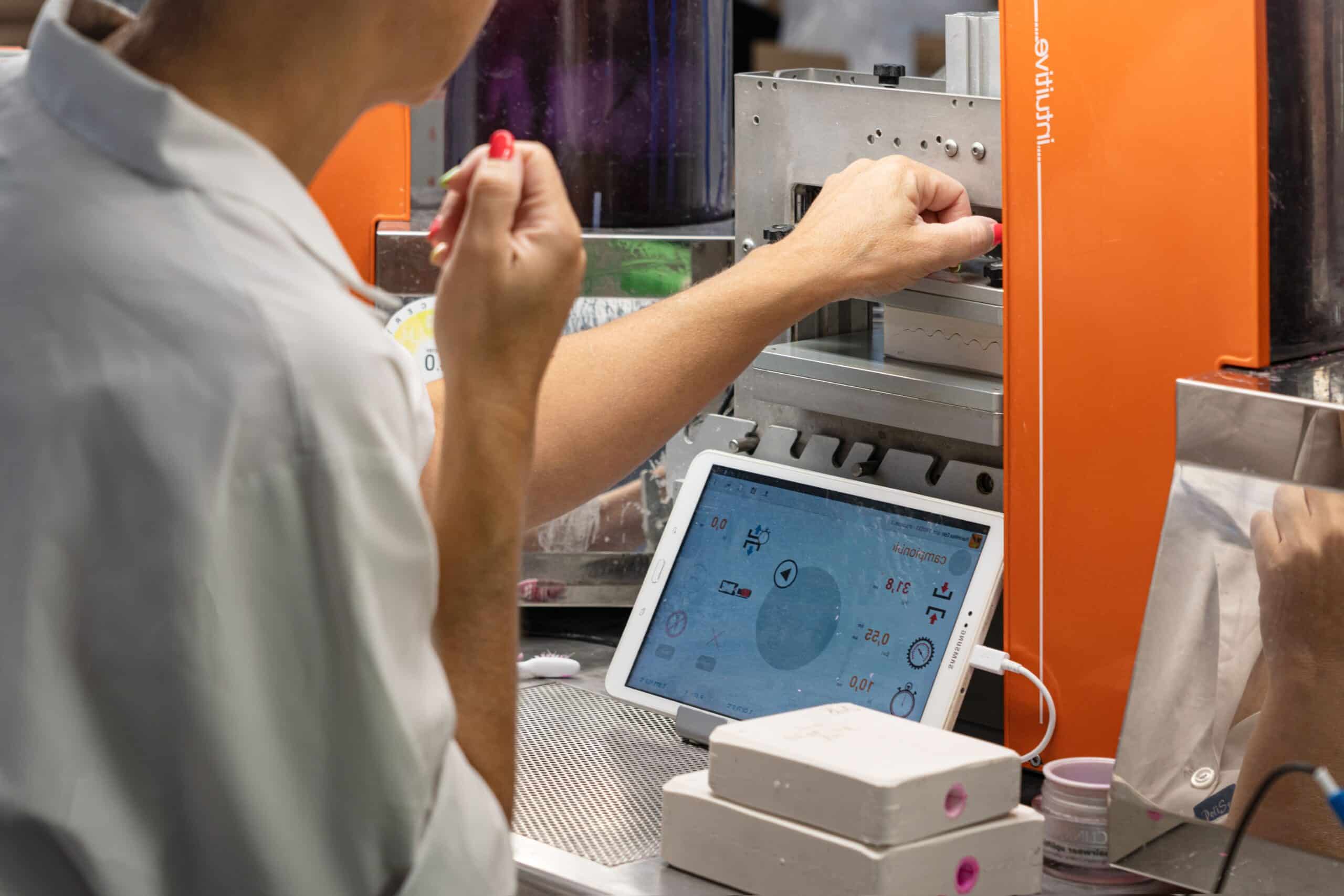
Wax Model Assembly Phase

Cylinder Preparation and Plastering Phase

Baking and Metal Pouring Phase
Cylinder Crushing Phase

Cylinder Scraping Phase

Pouring Channel Grinding Phase
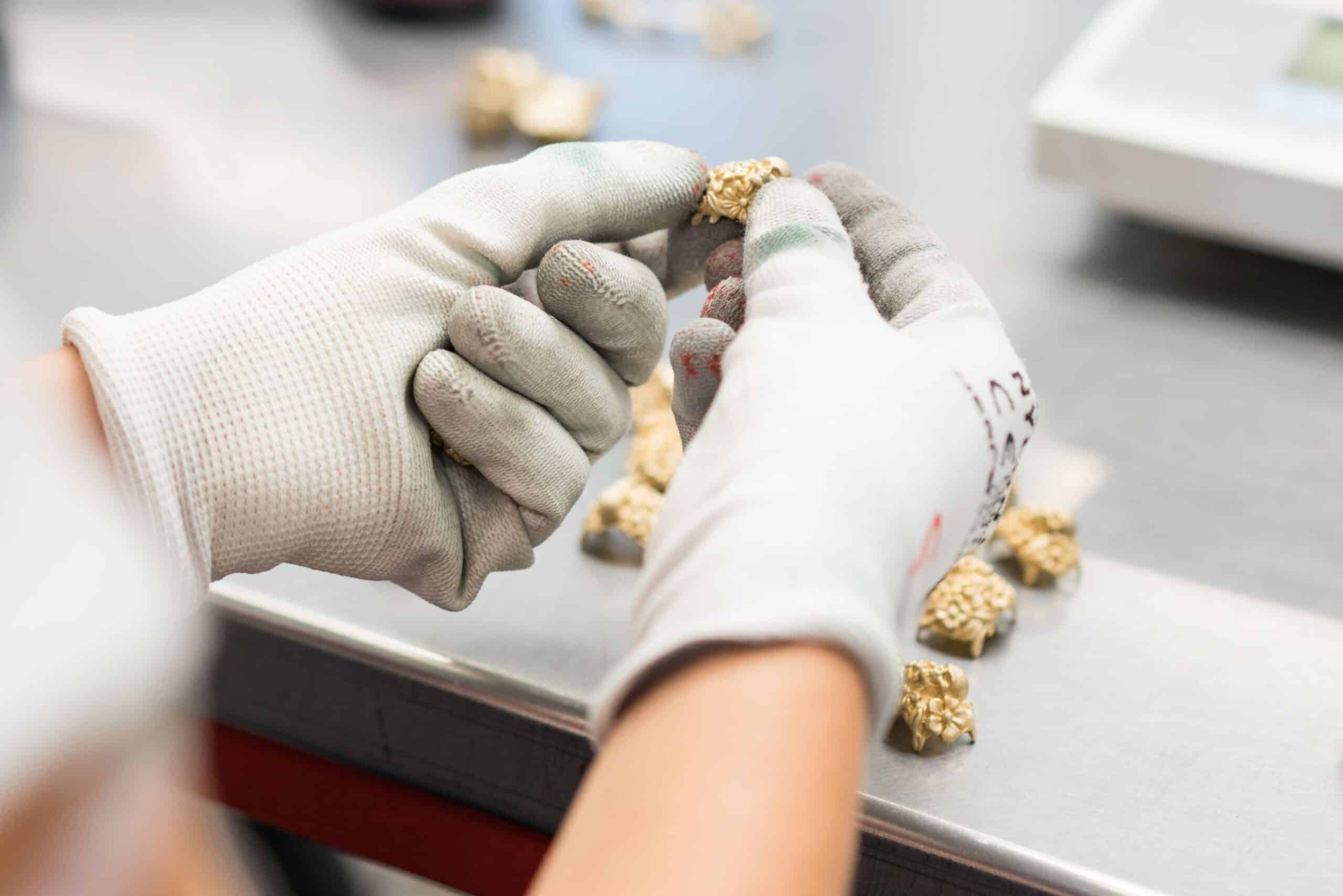
Testing and Quality Control Phase
Materials we cast for fashion and jewelry
The choice of alloy is driven by the end application: visible decorative parts, load-bearing hardware, jewelry pieces and decorative components each require different metallurgical properties.
Brass, bronze and copper alloys
Brass is our most common base for fashion hardware and costume jewelry. Excellent castability, fine detail rendering, and full compatibility with the entire spectrum of galvanic finishes (gold, rose gold, ruthenium, gun metal, palladium). Bronze is used when a warmer base tone or higher mechanical strength is required. Copper alloys are available for specific projects.
Silver and gold alloys
For fine jewelry and high-end fashion bijoux, we cast silver alloys (including sterling silver 925) and gold alloys in a range of carats. These are typically reserved for limited editions, capsule collections and luxury programmes where material value matters as much as design.
Special alloys and nickel-free compliance
For specific technical or regulatory requirements we work with special alloys developed by trusted Italian foundries. All alloys we use are nickel-free and compliant with EU REACH regulations on nickel release for items intended for prolonged skin contact. Material certifications are provided on request.
Lost-wax casting for fashion accessories, jewelry and small leather goods


Fashion jewelry and bijoux
Lost-wax casting is the dominant process behind fashion jewelry production worldwide. Earrings, pendants, rings, bracelets, charms and necklace components — wherever fine detail, low weight and design flexibility matter — lost-wax casting is the default choice. For brands and designers building their first costume jewelry line, see our dedicated page on custom fashion jewelry manufacturing and our overview of high fashion costume jewelry production in Italy.
Metal hardware for leather goods and accessories
Buckles, decorative plaques, bag closures, rings, snap hooks, chain links and decorative components for handbags and small leather goods are typically produced with lost-wax casting. Detail consistency batch after batch is critical for luxury brands, and the lost-wax process is the only one that reliably delivers both intricate geometry and repeatability at scale. See our dedicated page on custom metal parts for leather goods and on metal components for bags.
Footwear and apparel components
Buckles for shoes and belts, eyelets, decorative metal trims, metal logo plates for apparel: many of these components are produced by lost-wax casting when the design requires depth, relief or detail beyond what stamping can deliver.
Lost-wax casting vs other manufacturing processes
Lost-wax casting is the right answer for a large share of fashion hardware projects — but not all. A short comparison helps the design choice:
- Lost-wax casting — best for intricate geometries, fine details, decorative components and series production where consistency is critical. Strongest fit for fashion jewelry, leather goods hardware and decorative apparel components.
- SLM / DMLS metal additive manufacturing — best for prototyping, design iteration and very small series. No tooling required, but unit cost is higher and surface finish needs more post-processing.
- Stamping and pressing — best for flat, repetitive components with simple geometry, produced in very high volumes. Lower unit cost but limited design freedom.
- CNC machining — best for high-precision functional parts, but generally not cost-effective for complex decorative shapes typical of fashion hardware.
For many projects the optimal answer is a combination: SLM/DMLS for prototyping and design validation, then lost-wax casting for series production.
Working with an Italian lost-wax casting manufacturer
Micromet has built its production capability around lost-wax casting since the company was founded. Our positioning combines:
- Italian craftsmanship, with all phases of the process — design, master model, wax injection, casting, finishing, quality control — handled in our Arezzo facility
- Industrial capacity, with the ability to manage programmes up to two million pieces per year
- Flexibility on volumes, from prototyping and capsule collections to mass production
- Confidentiality, with NDA-protected collaborations as our standard mode of work
- End-to-end service, from CAD design through to plated, finished and quality-controlled metal parts ready for assembly
We serve fashion brands, designers and leather goods producers across Italy, France, the rest of Europe, the United Kingdom, the United States and selected international markets. For a wider overview of our offering, see our page on Italian metal accessories manufacturer for fashion brands.
Frequently Asked Questions About Lost-Wax Casting
What is lost-wax casting?
Lost-wax casting is a manufacturing process that uses a wax model of a part to create a ceramic mould. The wax is melted out (“lost”) to leave a cavity, into which molten metal is poured to produce the final piece. The technique allows highly detailed and complex metal geometries that would be difficult or impossible to achieve with stamping or machining. It is one of the oldest metalworking techniques and is still the preferred process for jewelry, fashion hardware and high-detail components.
What materials can be used in lost-wax casting?
Lost-wax casting is compatible with a wide range of metals and alloys. At Micromet we typically cast brass, bronze, copper alloys, silver and silver-based alloys. Special alloys can be used for specific projects. All alloys we work with are nickel-free and compliant with EU REACH regulations on nickel release for items in prolonged skin contact.
Is lost-wax casting suitable for jewelry and fashion accessories?
Yes — lost-wax casting is the dominant process for fashion jewelry, costume jewelry and luxury metal hardware. It allows fine reproducible detail (engraving, bas-reliefs, complex shapes) and works across the production volumes typical of fashion industry: from sampling and capsule collections to mass production runs of millions of pieces per year.
What is the difference between lost-wax casting and investment casting?
The two terms are often used interchangeably. “Investment casting” is the industrial term for the modern, large-scale version of the lost-wax technique; “lost-wax casting” is the traditional name. The underlying process is the same: a wax pattern is invested in a ceramic mould, the wax is melted out, and molten metal is cast in the cavity.
What MOQs do you support for lost-wax casting production?
Our setup allows us to work both on small pre-series and capsule collections (sampling, prototyping, limited editions) and on large industrial runs. We typically handle programmes up to two million pieces per year. Minimum order quantities are discussed case by case based on part complexity, finishing requirements and total project value.
Start a lost-wax casting project with Micromet
Whether you are developing a single jewelry capsule, a seasonal hardware collection or a continuous supply programme, our team can review your brief and propose a production pathway.
Contact us — we’ll come back with a feasibility assessment and a quotation framework.